


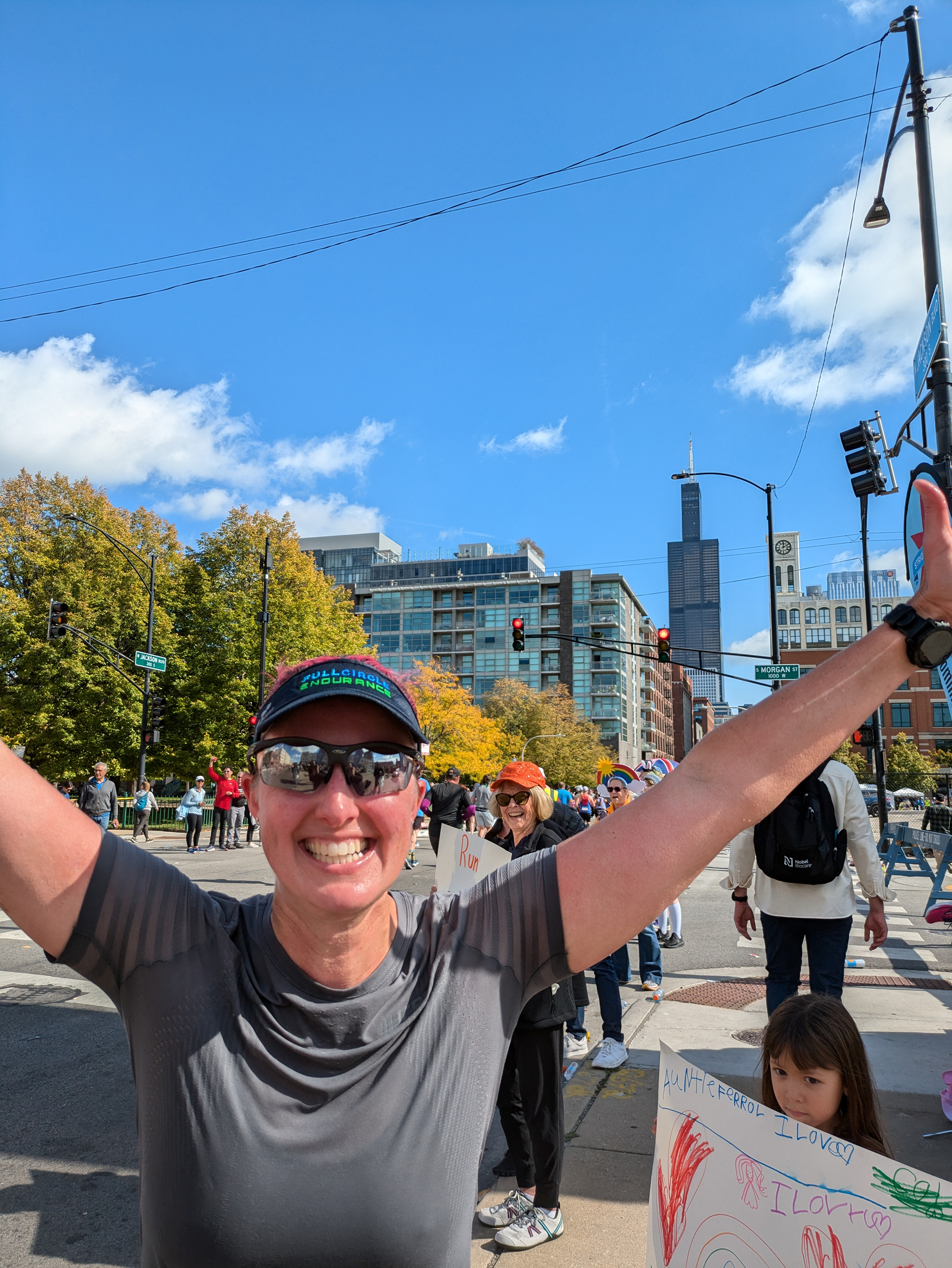
On Sunday, October 13, 2024, I ran the Bank of America Chicago Marathon in Chicago, Illinois.
Running the Bank of America Chicago Marathon has been a recent goal of mine, though it honestly wasn’t always a race I had interest in doing. I have a goal to do a race - any kind of race, not necessarily a marathon - in each of the 50 states. When selecting a race in a particular state, I try to seek out races that “feel” like the state I’m visiting. For instance, I did a mountain climb-a-thon (where you climb a mountain as many times as you can within 10 hours) in Alaska, an open water swim in Hawai’i, and I ran the Walt Disney World Marathon in Florida.
When it came to choosing a race in Illinois, one of my early criteria was honestly that the race not be the Bank of America Chicago Marathon. To me, it felt too cliché (it’s practically the only race Illinois is widely known for) and I felt that there must be another race that was more interesting to do.
But this all shifted a few years ago, and all of a sudden, I had felt the spark of desire to do this race. I cannot say why this changed; all I know is that it did. I was actually excited about the idea of doing it, which told me that it was the right race for me to target. As I preach all the time: Any goals that an athlete sets should be authentic and matter to them. I do actually take my own advice on this; what kind of hypocritical person and coach would I be if I said one thing and then did another myself?
The Bank of America Chicago Marathon is well-known for being a fast course (as of the time of my writing this, both the men’s and women’s marathon world records are currently on its course) and it is an Abbott World Marathon Major. Both of these things make this race very popular with runners, and getting a spot in the race can be challenging due to the demand for them.
Because it is so popular, the organizers of the Bank of America Chicago Marathon use a combination of time-based qualifications, charity slots, race-based guaranteed entries, and a lottery to assign race registrations. I am not fast enough to qualify for this race on time, the charity option wasn’t something I was interested in, and I live in Syracuse (so I couldn’t easily do the race series that would guarantee me a spot), so I had to enter the lottery to get a spot. The lottery is relatively competitive; in 2024, 160,000 people applied for the approximately 30,000 spots that are available to lottery registrants for the 2025 edition of the race. I was not selected the first few times I entered, and it took me a couple of years to get accepted through the lottery. I was ultimately accepted into the 2023 Bank of America Chicago Marathon.
At the time of my selection, I had never - ever - successfully made it to the start line of a race when I registered for said race more than six months in advance. Unexpected injuries and life happenings have thwarted my best-laid plans each and every of the five times I’ve attempted to do this. The lottery for the Bank of America Chicago Marathon is completed in early December and race day is in October, which means that I was registered for this race a full ten months in advance. Fate struck again, and I was ultimately unable to do the race in 2023 due to a combination of injury and life circumstances.
But! The Bank of America Chicago Marathon does have a lovely policy that allows you to guarantee yourself entry into the following year’s race if you cannot - for any reason - do the race in the year you were selected for. You do have to pay the entry fee again, but you don’t have to go through the lottery, get a qualifying time, run a series of races, or raise money for charity to get a spot. I elected to take my chances and take my guaranteed spot into the 2024 race. As I’ve talked about before: If the financial loss of my $245 entry fee (well, my $245 entry fee times two, so a total of $490) has that significant of an impact on my financial life, I have no business signing up for this race in the first place. So, I paid the entry fee again and secured my spot in the 2024 race.
As the calendar turned to 2024, I was determined to manage my training well so that I could actually start the Bank of America Chicago Marathon. In fact, when I was setting my goals for the year, my first goal was “Start the Bank of America Chicago Marathon.” My second goal? “Finish the Bank of America Chicago Marathon.” Seriously. That was it. I did not have any goals other than that. And no, I did not have any secret goals. I was not harboring some time in my head that I wanted to finish the race in. After my four-plus year journey to get into the race and after paying its entry fee twice, I truly did not care about anything other than being healthy enough to start it and strong enough to finish it.
One of the things that had prevented me from doing the race in 2023 was that I sustained an overuse injury in my training build to Grandma’s Marathon, which I ran in June 2023. As I’ve talked about in the past, being self-coached is very challenging, even for a coach who knows a lot about physiology and training plan design. This is because it is impossible - impossible - to be unbiased when we are considering our own selves and our own training.
While I feel like it’s very fair to say that I am now an effective coach for other athletes, it has taken me over 10 years of coaching and over 15 years as an endurance athlete to feel like I am even somewhat capable of coaching myself. That being said, I still occasionally make really stupid mistakes when I am managing my own training, and this is what happened in 2023. I made the classic, rookie mistake of pushing for too much too soon. When I was being coached by Coach Adam Ruszkowski, he would hold me back from this, which is hard to appreciate when it’s taking place. That being said, once you experience the opposite of it, you absolutely appreciate having a coach to guide you and offer an alternative perspective. Last year, without another person to check me and rein me in, I stepped just far enough over the line to cause an overuse injury to myself, and it sidelined me for the better part of six months.
So in 2024, I was determined to not bring about my own demise. I maintained my foundation of strength training by strength training twice per week in person with a strength coach. I started this routine of consistent strength training with Coach Adam in March 2021, but ultimately parted ways with him when his physical therapy business started taking off and he needed to dedicate more time and resources to that business. I then worked with Coach Jack, who has a weightlifting background and designed a program for me that made me feel stronger than I ever have.
Unfortunately, Coach Jack decided to move to Denver, Colorado at the beginning of August. (I mean, he should have consulted me before he made such a choice and abandoned me, right? Right?!?!) Very thankfully, I was able to find a new strength coach who has been excellent: Coach Jose. Between Coach Jack and Coach Jose, I had a strong foundation of strength in 2024, and this undoubtedly contributed to my staying healthy and injury-free throughout the year.
In addition to being wise while planning my running training, I remained consistent with and did not drop or neglect the “extras” that I’ve learned are critical for me: stretching, mobility work, getting quality sleep, massage, chiropractic care, daily hydration, workout fueling and hydration, and moving more than just in my workouts by averaging at least 5,000 additional steps in addition to my workouts each day.
All too often, I watch athletes reduce extras such as these in favor of their “real” workouts. I do understand why they do this (as I’ve done it myself!) Age-group athletes are time-starved and only have a limited amount of time to spend on training-related things. That being said, one of the biggest lessons I’ve personally learned over the years is that these supporting elements are what make it possible to do “real” workouts. Therefore, if I don’t have time for them, I don’t have time for “real” workouts. And if I don’t make time for elements such as these, the decision about how many “real” workouts I do will be taken from me when I get injured and need to alter my training as a result. So now, I make sure to plan my workouts and overall workout volume with this in mind, and I account for all of the time I’ll need - workouts plus extras - when I’m planning out my overall training.
I’m delighted to report that I remained injury-free throughout my training for the CHicago Marathon, and I took off for Chicago ready to (finally!) run this race. Race day dawned and the weather was absolutely perfect: Mostly Sunny, 58ºF at the start and 64°F when I finished with an average of 64% Humidity, 51ºF Dew Point, UV Index 2, 5-8 mph Wind out of the West throughout the race.
On race morning, I used a massage gun on my feet and calves before leaving my AirBnb for the race. I also used the lacrosse ball on my calves. I stretched in the grass in my corral area while waiting for the race to start.
I started closer to the back of Corral K and did some dynamic warm-ups while I was standing in the corral before they started us. I felt calm and excited before the start and as things were getting going. Due to my Corral (which was further back), I was limited in terms of stride length and speed for a lot of the beginning of the race due to the congestion throughout the course.
I followed a run/walk strategy throughout the race (which was identical to how I had trained). I ran five minutes at a sustainable effort (4 on a scale of 1-10) and walked for 90 seconds for all 26.2 miles. I normally train with my beloved Nathan hydration vest, but hydration vests are not allowed at the Chicago Marathon. I practiced with a 20-ounce bottle that was stored in the middle of my lower back on a waist belt in training and it worked well enough (not great, but well enough) that I decided to use that on race day. I also know from past experience that I can consume Gatorade Endurance Formula without issues, which enabled me to be confident that I could use the aid stations on the course successfully. I drank at every aid station and used my Nathan bottle when I was walking in between aid stations. I walked every aid station even if it wasn't a designated walking interval. I stopped to refill my bottle twice and stopped to use the restroom twice at different aid stations.
I ran entirely on feel. I noticed my heart rate monitor was inaccurate; I took it off, but it was still reading from the strap for a while (and reading too low). Once I disabled the strap in my watch, my heart rate seemed be recording accurately via the optical sensor based on what I know given heart rates feel like.
Spectators crossed the course all the time...more than I have ever seen at a race before. I actually got run into and almost knocked down by one guy. Even the people on the side of the course who witnessed it were like “WTF, mate?” They honestly were interfering with the race a lot of the time, which further complicated things. I felt like I really needed to pay attention the entire time, both to the terrain itself (there were a lot of potholes and a lot of lips between bridges, asphalt, and concrete) as well as with the people who were everywhere.
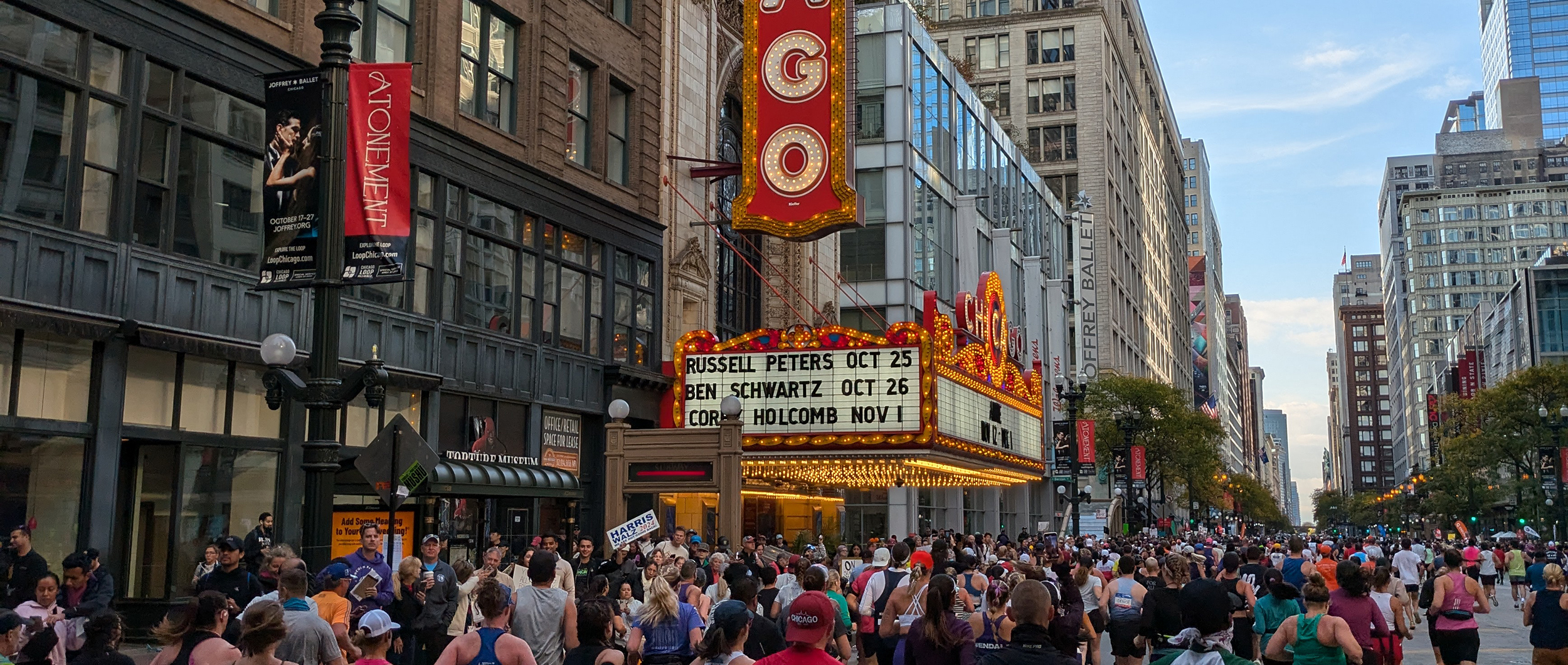
The spectators along the course were extremely enthusiastic, but not as loud or overwhelming as I remember the spectators on the course of the New York City Marathon being. I enjoyed a lot of the on-course entertainment. There was a drum corps, countless people playing music on their own, random people handing out tissues (which is an excellent idea that I've never seen at another race), people with Question Mark cubes from Mario spraying confetti at random intervals, kids with "Power Up" signs, kids high-fiving, and more. My favorite was a guy with the biggest smile who high-fived me around Mile 23 or Mile 24 and told me I could do it. I was a bit on the struggle bus at that point, so that was a big pick-me-up. There was a guy running dressed as Batman that I ended up leapfrogging for several miles, which I enjoyed.
I felt like the time on the course flew by until Mile 20-ish. I honestly felt like it was going by too quickly and I was a bit sad about it. In the final 10K, the bottoms of my feet started to hurt and really bother me. Putting weight on them was a very real challenge. I've never had this happen before, and it was different from the normal "I'm tired because I'm past Mile 20 of a marathon" sensation.
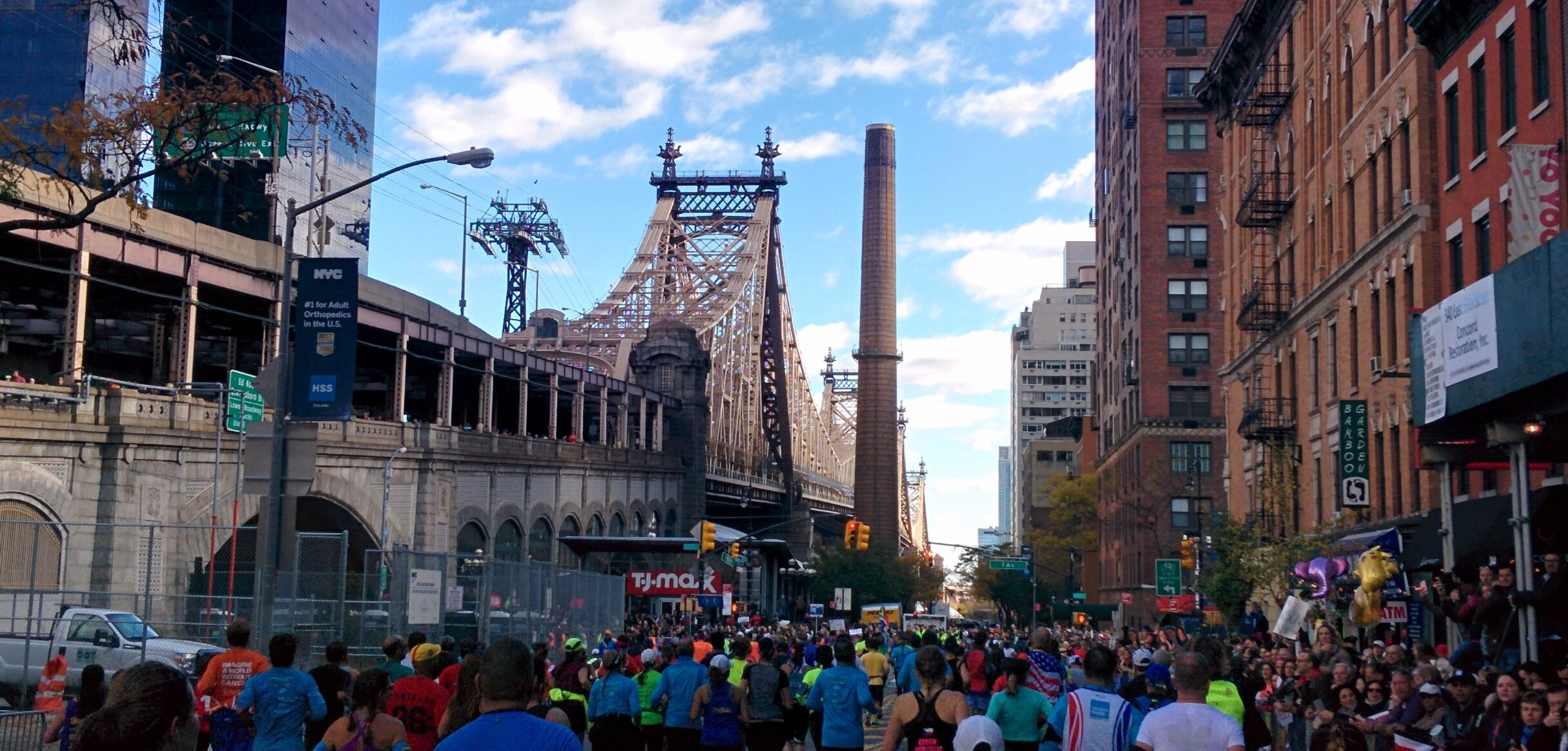
When I finished, I felt like my feet were going to explode out of my shoes. A nice volunteer loosened my laces for me. I thought about going to the Podiatry Medical Tent (yes, they actually had one), but I ended up going to the Mile 27 Post-Race Party hoping against hope that they would have a post-race massage area. They had physical therapists doing post-race stretching, so I took my shoes off, signed up, and waited in line. Just taking my shoes off really helped, but the PT (Rachel) must have worked on me for like 30 minutes at least. She used the massage gun on my feet, calves, and glutes and also did some gentle assisted stretching. At times the discomfort was A LOT, but by the end, I could walk like a normal person. I even was able to go down to the subway facing forward, which was NOT the case when I ran the New York City Marathon.
Walking around on Monday, I honestly felt great. I only had a touch of soreness in my hamstrings. I did use my Recovery Pump boots for at least two hours on Sunday night, but I really think that the post-race massage gun/stretching was a major reason that I felt so good on Monday.
I did a carb load heading into this race, which I've never done before. I followed the guidance from Featherstone Nutrition, which recommended a three-day carb load for me at about 710 grams per day. Despite my deep and life-long love of every single carbohydrate (I haven’t yet met one that I don’t like), I found that target challenging to hit, and I got 623 grams on Thursday, 597 grams on Friday, and 528 grams on Saturday. I increased my fluid intake to go along with the increase in carbohydrates and I think this all likely contributed to how I felt in the race and how I recovered as well.
Everyone talked about some “hill” toward the end of the race, but I never saw such a thing. I think that Chicago’s definition of “hill” and mine (from Upstate New York) are probably very different. My guess is that Chicagoans and Floridians probably have the same definition of “hill” (which is a slight grade change from flat).
Overall, I loved this. I felt so happy for days afterward and I feel so fortunate that I got such a beautiful day for a race like this.
In case there's interest, I've included the post-race notes I logged in Final Surge:
Weather Conditions: Mostly Sunny, 58-64°F, 64% Humidity, 51ºF Dew Point, UV Index 2, 5-8 mph Wind out of the West
Surface Conditions: Dry Asphalt / Concrete / Grated Bridges
Interesting/Exciting Things Observed: Batman running through Christopher Nolan’s Gotham
Hydration Consumed:
~40 ounces of Gatorade Endurance Formula (Nathan Bottle)
+ ~60 ounces of Gatorade Endurance Formula (Aid Stations)
+ ~12 ounces of Water (Aid Stations)
= 112 ounces total
Fuel Consumed:
~8.5 servings of Gatorade Endurance Formula (~185 grams, ~750 calories)
+ 9 HUMA+ Gels (189 grams, 900 calories)
= 374 grams, 1,650 calories total
Fueling/Hydration Intervals:
Hydration:
~2-4 ounces of Gatorade Endurance Formula every time I walked (every 6:30). Water at the final 4-5 hydration intervals/aid stations.
~20 ounces total consumed each hour
Fuel:
Gatorade Endurance Formula at the Hydration Intervals.
0:30 - HUMA+ Gel (Caffeine)
1:00 - HUMA+ Gel (Caffeine)
1:30 - HUMA+ Gel (Caffeine)
2:00 - HUMA+ Gel (Caffeine)
2:30 - HUMA+ Gel (Caffeine)
3:00 - HUMA+ Gel (Caffeine)
3:30 - HUMA+ Gel (Caffeine)
4:00 - HUMA+ Gel (Caffeine)
4:30 - HUMA+ Gel (Caffeine)




Laura Henry is a Syracuse, NY-based coach who is a USA Triathlon Level II Long Course and Level II Paratriathlon Certified Coach, USA Cycling Level 2 Certified Coach, VFS Certified Bike Fitter, SICI Certified Bike Fitter, and has successfully completed NASM's Certified Personal Trainer course. Coach Laura is passionate about helping athletes of all ability levels reach their goals and has coached hundreds of athletes to success over the course of her career.
She can be reached at Laura@FullCircleEndurance.com.
Have a question or ready to get your TRAINING started?
Fill out our Contact Form to the right and we will get back to you shortly!
.svg)

