


There are countless pieces of advice to offer to marathon runners and there are many, many best practices that runners should implement on race day when they run 26.2 miles. However, even if the same distance (26.2 miles) is covered in all marathons, each individual race has specific things that make it different from other marathons. These are the best tips for runners seeking to run through all five boroughs of New York City in the TCS New York City Marathon!
(If you’re seeking some guidance on your training journey to the New York City Marathon, be sure to check out our NYC Marathon Training Plans!)

Relative to other Abbott World Marathon Major races (such as the Chicago Marathon, the Berlin Marathon, the Tokyo Marathon, and the London Marathon), the New York City Marathon is hilly (only the Boston Marathon and Sydney Marathon have more elevation gain!). The largest hill is right at the start of the race (the Verrazzano-Narrows Bridge is actually the largest hill in the race!), but there are rolling hills throughout the rest of the course and there are a couple of good hills in the final 5K. It’s important to prepare for this constant demand to go up and down hills in training by doing some hill-specific training runs and by including hills in your long runs.
By hill-specific training runs, I mean workouts that focus both on going uphill and going downhill. All too often, I see athletes focusing on workouts where they are working on their hill climbing skills and speed, but it’s honestly even more important to work on developing the durability, resilience, confidence, and skills to run well downhill because of how much more force the body absorbs on descents.
I plan hill repeat workouts for my athletes training for the New York City Marathon that focus on both of these things. For instance, in one workout, the focus will be on doing repeats of hills and focusing on climbing strength and skills. In these workouts, the work intervals are the climbs and the recoveries are the descents back down to the bottom of the hill. Then, in a different workout (and in a different training week), I plan a hill repeat workout where the focus is on descending. In these workouts, the work intervals are the descents and the recoveries are the climbs back up to the top of the hill.
Purchase inexpensive sweatpants, a sweatshirt, gloves, and a hat at a thrift store or somewhere like Wal-Mart to wear over your race outfit before the race starts. While the weather for the race itself has historically been very good (there’s only been significant rain twice in 40 years and the average temperature during the race is 46-60ºF / 8-16ºC), it’s usually colder on race morning while you’re waiting for the race to start. Speaking of waiting for the race to start: There is a long wait between when you need to arrive on Staten Island and when the race actually starts. There will be bins to collect any clothing you no longer want in the corrals at the race start; these items are donated to charity after the race.
The New York City Marathon traditionally takes place on the first Sunday in November, which falls on the day that Daylight Saving Time ends in the United States. Be sure that you set any clocks that need setting and/or make sure that your phone or other connected device is updating the time properly. Then, enjoy the extra hour of sleep you get before your race morning wake-up time!
New York City has been called “The City That Never Sleeps”, but this is honestly a complete lie on Sunday mornings in New York City. Very few things are open early on Sundays, and this includes public restrooms and breakfast spots. Be sure to purchase whatever you want to eat for breakfast before the race on Friday or Saturday and bring it with you to Staten Island. Also be sure to be aware that you may not encounter open restrooms again until you reach the marathon Start Village on Staten Island.

There are two main/official ways to the start area on Staten Island: Buses from Midtown or New Jersey and the Staten Island Ferry from Manhattan. You can also be driven over the Verrazzano-Narrows Bridge (via rideshare or being driven by friends/family) if you go early enough. However, the bridge closes at 7:00 a.m. to all vehicle traffic for the entire day, so be sure to consider that if you do have someone drive you over. If you’re already on Staten Island, you can walk, bicycle, or rideshare to the start, but be aware that the roads get quite crowded. All transportation options to Staten Island on race morning take quite a bit of time. The buses take about 90 minutes (and there are not any restrooms available on the buses). The ferry takes about 25 minutes, but you need to get in line for a bus from the ferry dock to the race start area once you’re on Staten Island, which adds more time. Taking the Staten Island Ferry is a pretty iconic New York City Experience; you cross the Hudson River and pass the Statue of Liberty on the way to Staten Island.
There are five start waves in the New York City Marathon. These waves typically range in start time from 9:10 a.m. to 11:30 a.m. However, the race organizers close down the Verrazzano-Narrows Bridge to all vehicle traffic starting at 7:00 a.m. So, this means that you will likely need to arrive on Staten Island before 7:00 a.m. and that you will have up to 4.5 hours to wait on Staten Island before your race starts. Be sure to pack all the food and clothing that you need during that time. Bring an extra blanket or cheap plastic poncho to use as a ground covering if you’d like to sit or lie down in the (wet, cold) grass on race morning in the waiting areas.

In addition to five start waves, there are also three start colors in the New York City Marathon. The waves indicate the time you will start the race and the colors indicate where on the Verrazzano-Narrows Bridge you will start and which path you will follow for the first eight miles of the NYC Marathon. You are not allowed to move to an earlier (faster) starting wave or color, but you are allowed to move to a later (slower) wave or color. Two of the starting colors run on top of the Verrazzano-Narrows Bridge and the other starting color runs on the bottom of the bridge. The best views and best experience are on the top of the bridge, so if you are assigned the start color that goes on the bottom of the bridge, consider moving back to a different start time and different start color so you can run across the top of the Verrazzano-Narrows Bridge.
Unlike many other Abbott World Marathon Major races, hydration vests and hydration belts are allowed in the New York City Marathon. However, there’s an odd stipulation that comes along with this: You cannot have an actual bladder in the bladder section in the back of a hydration vest. You can wear the vest, but that back section cannot hold a hydration bladder. If a hydration vest + bladder is something you typically train with, be sure to practice with alternative hydration vessels that are allowed at this race. Also be sure to train with the hydration options that are going to be available on-course since you will most likely be unable to provide all of your own hydration throughout the race due to the limitations on what you’ll be able to carry with you.

You are not allowed to check a bag on race day at the New York City Marathon. At the Race Expo, you will be given a clear Start Village Bag, which is the only bag you can take with you to the start (unless you’re carrying/wearing a hydration vest throughout the race). Any items that you place in your Start Village Bag will be disposed of, so don’t put anything in there that you don’t want to lose. Be sure to plan ahead for exactly what you are going to carry on your person throughout the race and keep those items packed on your person when you travel to the start area on race morning so you don’t inadvertently lose something important like your phone.
You are allowed to Pre-Check a bag Thursday-Saturday at the New York City Marathon that you will be allowed to retrieve after you finish the race in Central Park on Sunday. Pre-Checking a bag is optional, but is a good idea, especially if you'd like to have warm, dry clothes or different shoes after you finish the race. There is a very long walk after the end of the race (1.5-2 miles), so having some dry clothes waiting for you can be really helpful. Don’t put valuables in this bag in case something goes awry.
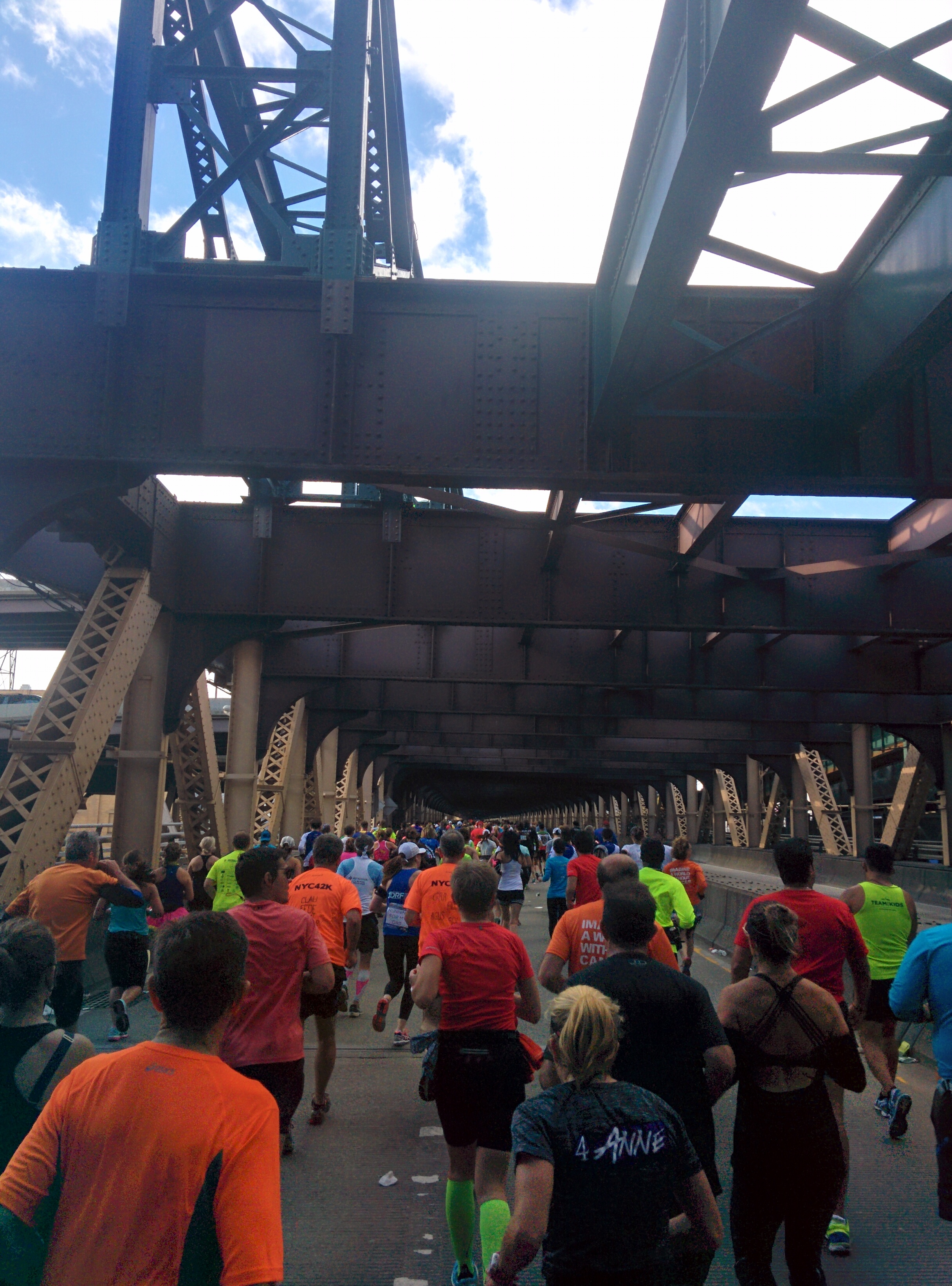
The NYC Marathon is the largest marathon in the world. Marathon Sunday is the busiest day in New York City other than Thanksgiving Day (when the Macy’s Thanksgiving Day Parade takes place). Crowds of people line literally every section of the course they possibly can; the only sections of the course that do not have spectators along them are the five bridges that are part of the course. This means that all 26.2 miles of the New York City Marathon are loud. If you are someone who is sensitive to loud noises for long periods of time, this is something to be aware of and mentally prepare for.
If you will have friends and family cheering for you in New York City, coordinate with them ahead of time to decide which side of the course they should wait for you on (“runner’s left” or “runner’s right) so you can be sure to be running on that side of the course during the race. As mentioned earlier, the course is very crowded and there are also millions of spectators that come out to cheer runners on during the race. Discussing this ahead of time with your family and friends will give you all the best chance of being able to see each other. Also be sure to plan a reunion spot post-race ahead of time so you know where to find each other after you finish.



Laura Henry is a Syracuse, NY-based coach who is a USA Triathlon Level II Long Course and Level II Paratriathlon Certified Coach, USA Cycling Level 2 Certified Coach, VFS Certified Bike Fitter, SICI Certified Bike Fitter, and has successfully completed NASM's Certified Personal Trainer course. Coach Laura is passionate about helping athletes of all ability levels reach their goals and has coached hundreds of athletes to success over the course of her career.
She can be reached at Laura@FullCircleEndurance.com.
Have a question or ready to get your TRAINING started?
Fill out our Contact Form to the right and we will get back to you shortly!
.svg)

